How Much Does a 4-Post Car Lift Cost?
Garage planning considerations before budgeting for a 4-post car lift and related upgrades.
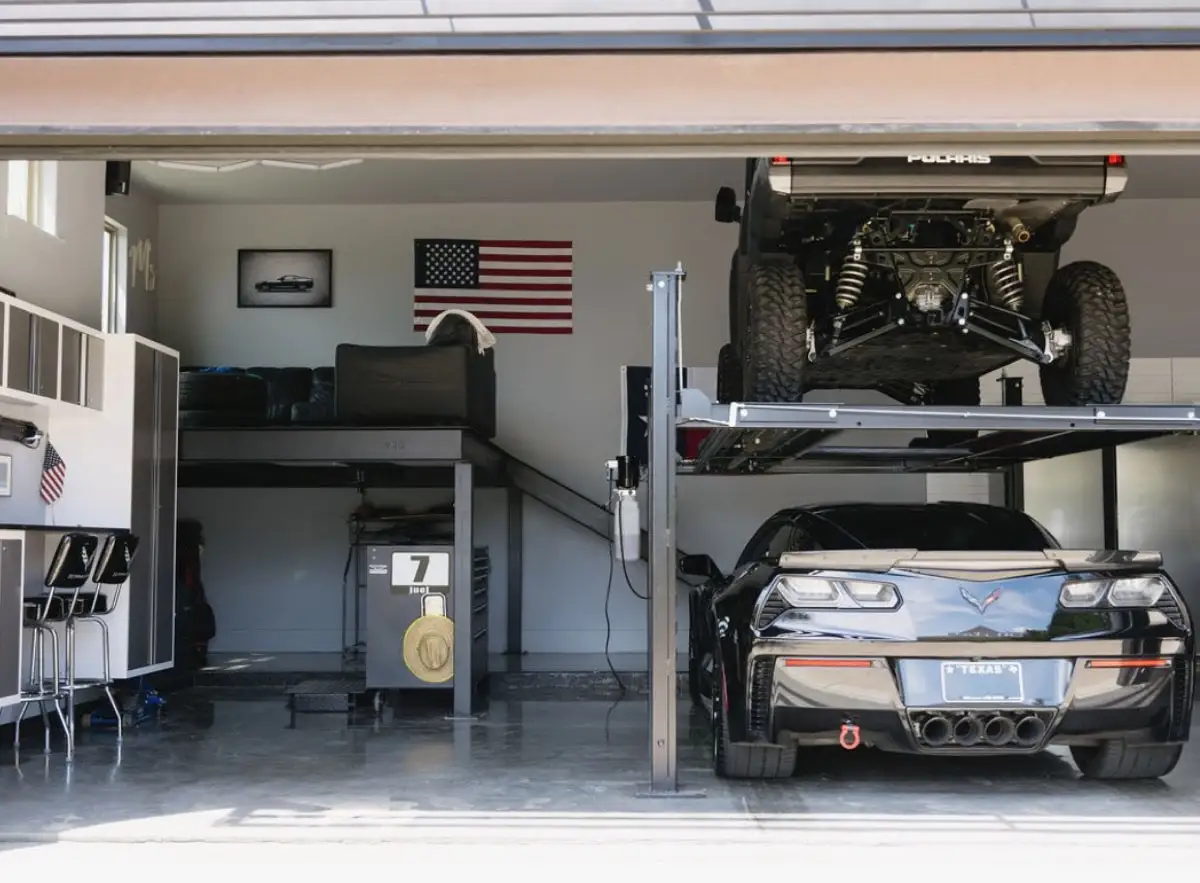
The equipment is rarely the expensive part of putting a car lift in a house, and it is almost never the part that kills the project. Ceiling height is. Take that one measurement before you call a dealer, because it decides which kind of lift you can actually own, and sometimes it decides that the answer is none of them.
Lift pricing itself comes from the manufacturer or the dealer, and it moves with capacity, runway length and width, freight and options, so we are not going to quote you someone else's product. What we can tell you is everything that sits around the lift on the invoice, and which of those items surprises people.
What the total is made of
A 4-post lift purchase is normally six line items, and the dealer quotes one of them.
- The lift. Priced by capacity class, runway length and width, and finish. This is the number people research.
- Freight and offload. These ship on a pallet by freight carrier and arrive at the curb. Several hundred pounds of steel then has to get from the truck into the garage, which is either an extra service or a favor you will owe someone.
- Assembly and installation. Columns, crossmembers, runways, cables, hydraulics, and then a leveling and safety check.
- Options that are not in the headline price. Caster kits so the lift can be rolled aside, drip trays, a jack tray or rolling bridge, extended columns, aluminum approach ramps. Most of these are decided after the fact and each one is a separate line.
- Power. Some 4-post lifts run from a standard household circuit and some want 240 volts. Either way, a dedicated circuit positioned near the power unit is usually an electrician's visit, and the position matters because the cord is short and the power unit mounts on a column.
- The garage side. Slab assessment, floor finish under the bay, lighting over it, and relocating whatever storage currently lives in the footprint.
Items one through four are the lift. Items five and six are the garage, and they are where budgets get away from people because nobody quoted them at the start.
Do the height arithmetic before anything else
If the point of the lift is parking two cars in one bay, the math is not complicated and it is not negotiable.
Add together the height of the vehicle parking underneath, the thickness of the runways and crossmembers of the lift itself, enough rise for the lower car to clear comfortably, the height of the vehicle going on top, and a working margin so you are not holding your breath. Use your own vehicles' published heights, not estimates.
Run that with two ordinary sedans and you will land in the region of eleven to twelve feet of clear height. Run it with anything tall on either level, an SUV underneath or a truck on top, and it climbs past thirteen. Austin garages are commonly framed at eight to ten feet. That is why most residential 4-post lifts in this market end up used for service work and for storing one low car, not for stacking two.
Measure to the lowest obstruction, not to the drywall. The open garage door panels sit a few inches under the ceiling and run back into the room roughly as far as the door is tall, the opener rail hangs down the centerline, and light fixtures and any existing racks are below that again.
There are three ways to buy height, and they are worth knowing before you conclude it cannot be done:
- A wall mounted jackshaft opener replaces the ceiling rail and motor head, freeing the centerline.
- A high lift or vertical lift track conversion sends the door panels up the wall instead of back under the ceiling, which clears the whole span behind the opening. It needs headroom above the door and normally a jackshaft opener to go with it.
- Raising the ceiling, which is a real project with a real permit conversation attached, and occasionally the right answer in a detached or oversized garage.
The slab
A 4-post lift spreads its weight over four base plates rather than concentrating it into anchor bolts at two, which makes it the gentler of the two common designs on a residential slab. Many are designed to be free standing, which is also what makes a caster kit possible. That does not make the slab a non question.
Two things have to agree. The manufacturer publishes a minimum slab thickness and concrete strength for the equipment, and your garage has whatever it has. Residential garage slabs are commonly poured around four inches, which is a different thing from a shop floor, and thickness varies across a slab more than people assume. Flatness matters too, because a lift sitting on a slab that falls away toward the door has to be shimmed level, and a lift that is not level is a lift with an uneven load path.
Find out both numbers before the lift is ordered rather than after it is on the driveway. If the slab has cracking, spalling or a section that has moved, that gets resolved first regardless of what goes on top of it.
Four post or two post, and why it changes the bill
If you want to park two cars in one bay, or keep a car off the floor for months at a time, a 4-post is the answer. Drive on, no anchoring in most designs, and it can usually be rolled out of the way.
If you want wheels off, brakes and suspension work, a two post gives you the underside access a 4-post never will. It also concentrates its entire load into anchors in the slab, needs more clear height for the arms and the vehicle's full rise, and is the more demanding installation of the two by a wide margin. The equipment price is only half of that comparison.
Buy for the work you will actually do. A 4-post bought for occasional oil changes is a good buy. A 4-post bought because you intended to do suspension work is a lift you will resent.
The costs nobody puts in the spreadsheet
- Lighting. A car on a lift blocks the ceiling fixture and puts the bay underneath in shadow, which is where you will be working. Task lighting on the walls and along the sides of the bay, planned before the lift goes in, not after.
- The floor. You are going to spend time under a vehicle on that concrete. Bare slab sheds dust, holds every drip, and is unpleasant to lie on. A coated floor is the usual answer, and the ranges are in our Austin coating cost breakdown.
- Displaced storage. The lift's footprint and the ceiling directly above it both come out of your storage plan, and the ceiling above a lift is the part you can no longer reach.
- A parking space. While a car is up, the bay is committed. In a two car garage that is a real household cost, and it is the reason caster kits sell.
What to have in hand before you shop
Clear height at the lowest obstruction. The length and width of the bay with the door closed. What the slab is and what shape it is in. Whether you want storage or service. With those four answers a dealer's quote means something, and without them it is a number attached to an assumption.
We do car lift garage planning for Austin and Central Texas homeowners, which is the clearance, slab, floor, lighting and storage side of the project rather than the equipment. It is the half that decides whether the lift you buy fits the garage you own.
Get A Practical Garage Plan
We help homeowners turn 4-post car lift planning into a clear plan for floors, storage, cabinets, lighting, and layout.
Call (512) 881-9263 to talk through the garage, the timing, and the right next step.
Can My Ultimate Garage help with this?
We help Austin-area homeowners plan garage floors, storage, cabinets, overhead racks, lighting, and full garage remodels.
How do I get a quote?
Call (512) 881-9263 or use the contact page to schedule a garage estimate.
Ready to make the garage work harder?
Get a practical plan for floors, storage, cabinets, lighting, and layout before buying random products that do not fit the room.